
分离与支撑超平面
超平面分离定理
设两个凸集
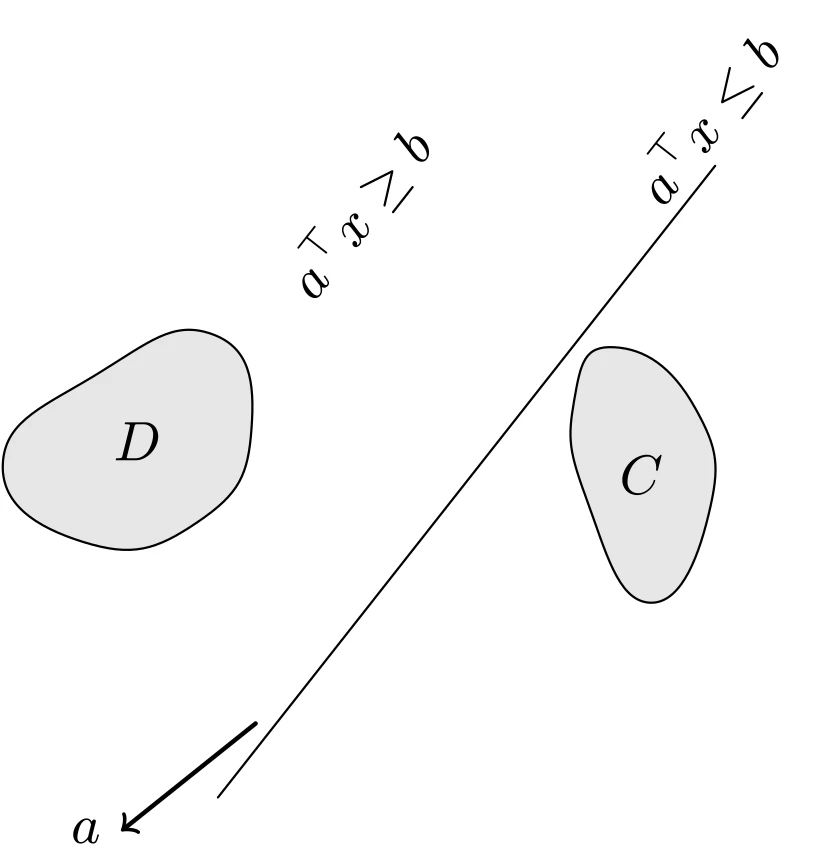
TikZ 代码
tex
\begin{tikzpicture}[line cap=round,line join=round,scale=0.85]
  % separating hyperplane of two convex sets
  \draw (-0.6,-2.1) -- (3.1,2.6);
  \node at (0.45,2.25) [rotate=52] {$a^{\top}x \geq b$};
  \node at (3.05,2.95) [rotate=52] {$a^{\top}x \leq b$};
  \begin{scope}[shift={(-1.7,0.3)}]
    \draw[fill=gray!20] plot[smooth cycle,tension=0.9]
      coordinates {(0.2,0.75) (1.05,1.05) (1.35,0.35) (0.95,-0.35) (0.1,-0.5) (-0.5,0.1)};
    \node at (0.5,0.25) {$D$};
  \end{scope}
  \begin{scope}[shift={(2.0,-0.1)}]
    \draw[fill=gray!20] plot[smooth cycle,tension=0.9]
      coordinates {(0.35,1.35) (0.95,0.9) (1.05,0.1) (0.6,-0.55) (0.15,0.2) (0.05,0.95)};
    \node at (0.55,0.4) {$C$};
  \end{scope}
  \draw[->,thick] (-0.32,-1.55) -- (-1.32,-2.35) node[left] {$a$};
\end{tikzpicture}
注:
分离不一定是严格的:上述定理只保证
与 ,两个集合可以同时接触分离超平面。 严格分离需要更强的条件:若
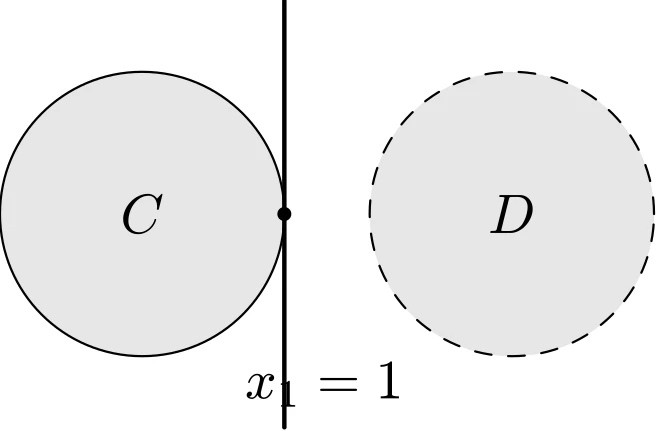
是闭集、 是紧集(有界闭集)且二者不相交,则存在 和 ,使得 不相交的凸集不一定能被严格分离。例如闭单位圆盘
与与之相切的开圆盘 不相交,虽然可以被超平面 分离,但由于 在点 处接触该超平面,任何分离超平面都无法使 严格地位于一侧,如图所示:
TikZ 代码
tex
\begin{tikzpicture}[line cap=round,line join=round,scale=0.9]
  % disjoint convex sets that cannot be strictly separated
  \draw[fill=gray!20] (0,0) circle (1);
  \node at (0,0) {$C$};
  \draw[dashed,fill=gray!20] (2.6,0) circle (1);
  \node at (2.6,0) {$D$};
  \draw[thick] (1,-1.5) -- (1,1.5);
  \node at (1.28,-1.2) {$x_1 = 1$};
  \fill (1,0) circle (1.4pt);
\end{tikzpicture}- 超平面分离定理的逆命题:不成立。
支撑超平面
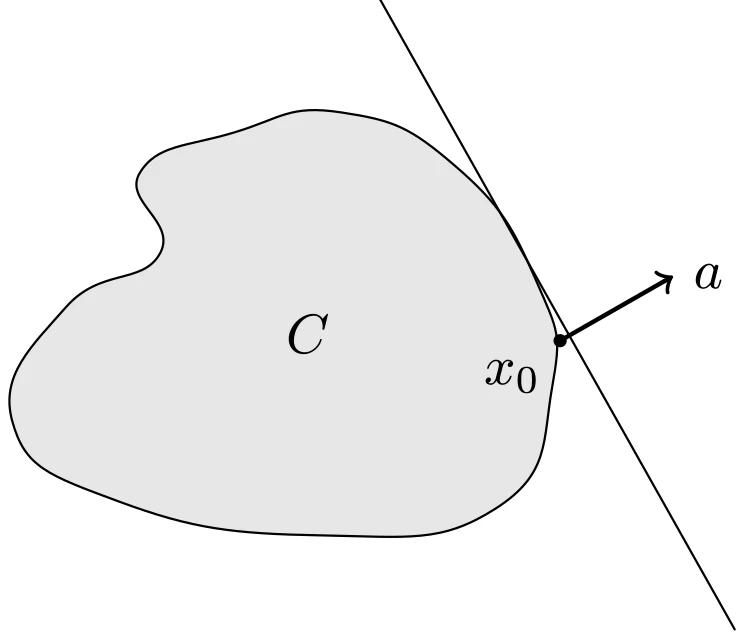
设
TikZ 代码
tex
\begin{tikzpicture}[line cap=round,line join=round,scale=0.85]
  % supporting hyperplane of C at boundary point x0
  \draw[fill=gray!20] plot[smooth cycle,tension=0.85]
    coordinates {(1.15,2.2) (2.0,1.8) (2.6,0.95) (2.72,0.15) (2.3,-0.75) (1.0,-0.95)
                 (-0.5,-0.7) (-1.3,-0.1) (-0.9,0.75) (-0.2,1.15) (-0.35,1.75) (0.35,2.05)};
  \node at (0.9,0.55) {$C$};
  \draw (1.44,3.04) -- (4.08,-1.65);
  \fill (2.78,0.5) circle (1.4pt) node[below left] {$x_0$};
  \draw[->,thick] (2.78,0.5) -- (3.62,0.98) node[right] {$a$};
\end{tikzpicture}支撑超平面定理:若
支撑超平面定理的逆命题也不成立:闭集在每个边界点处都有支撑超平面并不意味着它是凸的。